


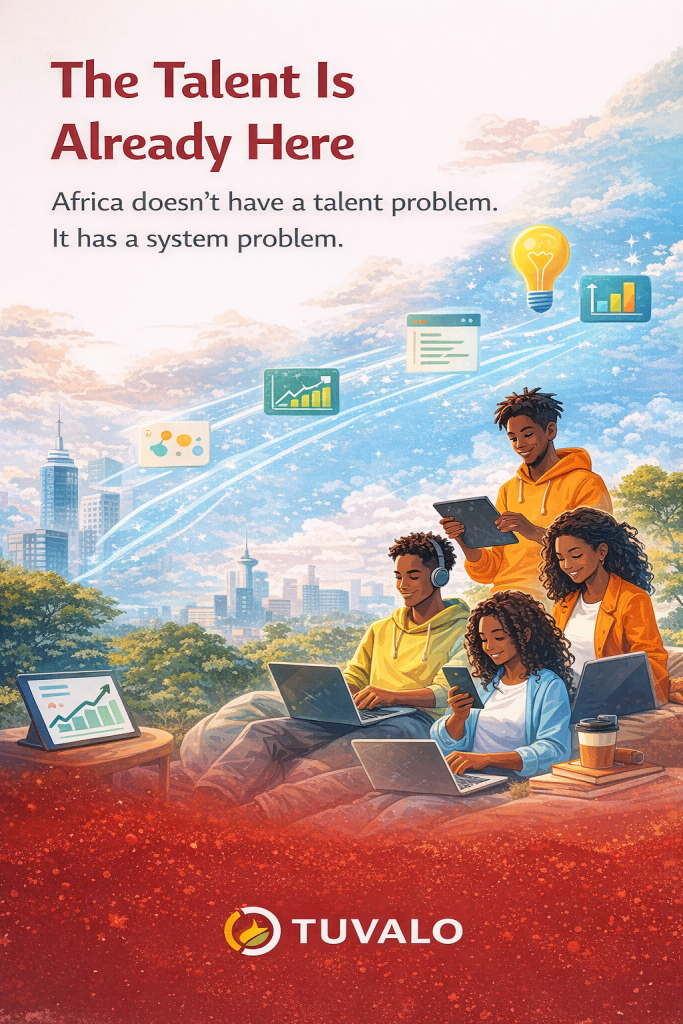
Let’s be clear about something:
Africa does not have a talent problem.
Walk through any city in West Africa—Ghana, Nigeria, Côte d’Ivoire—and you’ll find thousands of young people building skills, learning online, figuring things out as they go.
Designers. Developers. Creators. Marketers.
Most of them didn’t wait for permission.
They taught themselves.
So why does unemployment still dominate the conversation?
Because talent alone doesn’t create opportunity.
Busy, But Not Earning
There’s a quiet reality most reports don’t capture:
A lot of young people aren’t idle.
They’re active—just not earning consistently.
They’re:
- doing small gigs here and there
- managing social media for a friend’s business
- building portfolios no one sees
- learning skills they can’t fully monetize
It’s not unemployment in the traditional sense.
It’s something else:
Under-structured productivity.
People are working—but the work isn’t flowing.
Gen Z Is Already Operating Differently
This generation doesn’t think about work the same way.
They’re not just looking for jobs.
They’re:
- open to freelance and remote work
- comfortable learning from YouTube instead of classrooms
- building personal brands without calling them that
- thinking globally, even when working locally
The shift has already happened.
But the systems around them haven’t caught up.
The Real Problem: No Clear Pathways
Here’s the issue:
There’s no clear, reliable path from skill → income.
You can learn design.
You can learn coding.
You can even get good at it.
But then what?
- Where do you find clients?
- How do you prove you’re credible?
- How do you get paid consistently?
Most people figure it out alone—or not at all.
That’s the gap.
What This Means
If you zoom out, it becomes obvious:
Africa isn’t lacking talent.
It’s lacking structure.
And until that structure exists at scale, we’ll keep seeing the same pattern:
- high potential
- low conversion
- slow economic impact
But that’s starting to change.
Because the next phase isn’t about training people.
It’s about plugging them into real systems.