


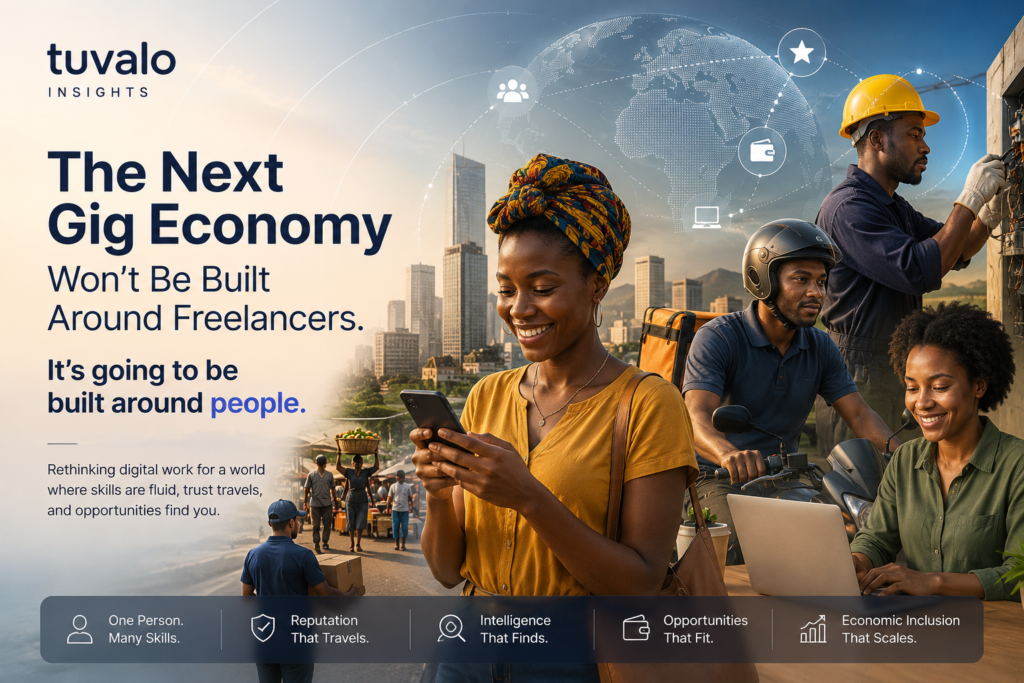
It’s going to be built around people.
The last fifteen years have been remarkable for the digital economy.
Freelancing platforms gave professionals access to global clients. Ride-hailing applications transformed urban transportation. Delivery platforms created entirely new forms of work. Local services became searchable with a few taps on a smartphone.
Collectively, these platforms helped redefine employment for hundreds of millions of people.
Yet they all share one common assumption.
They assume people fit neatly into one category of work.
A software developer writes code.
A driver drives.
A designer designs.
A courier delivers.
Reality tells a different story.
Across much of the world—particularly in emerging economies—people rarely have just one professional identity. They move fluidly between roles depending on opportunity, season, income needs, location and personal ambitions.
A university student may tutor online, design social media graphics, sell products on weekends and help local businesses digitize their operations.
An electrician might install solar systems, repair appliances, inspect properties and train apprentices.
A motorcycle owner could deliver groceries in the morning, transport parcels in the afternoon and support local commerce in the evening.
These are not exceptions.
They represent a growing model of work.
We Need Better Infrastructure, Not More Apps
Today’s digital labour market has become fragmented.
Every type of work has its own application.
Every application requires another profile.
Another reputation.
Another payment system.
Another verification process.
Another learning curve.
The result is that workers spend almost as much time navigating platforms as they do earning income.
Technology should reduce friction, not multiply it.
The next generation of work platforms will not ask people to choose a single professional identity.
Instead, they will recognise that every individual possesses multiple skills, changing availability and evolving capabilities.
The platform should adapt to the worker—not the other way around.
Reputation Should Travel With You
One of the most overlooked inefficiencies in today’s platform economy is fragmented trust.
Someone who has completed thousands of successful deliveries starts from zero when joining a freelance marketplace.
A highly rated designer begins again when moving to another platform.
An experienced technician rebuilds credibility every time they enter a new ecosystem.
This makes little sense.
Professional reputation should become a portable digital asset that grows throughout a person’s career, regardless of the type of work they perform.
The future belongs to systems where trust compounds rather than resets.
Skills Are Becoming More Fluid
Technology is accelerating one of the biggest shifts in modern employment.
People no longer build careers around a single occupation.
They build careers around combinations of skills.
Artificial intelligence will accelerate this transition.
Routine tasks will increasingly be automated, while human work shifts toward judgement, creativity, relationships, adaptability and specialized services.
The worker of tomorrow is unlikely to introduce themselves with a single job title.
Instead, they will describe a portfolio of capabilities.
Digital infrastructure must evolve accordingly.
Geography Is Becoming Less Important—But Still Matters
Remote work has shown that talent can exist anywhere.
At the same time, millions of services will always remain physical.
Homes still require repairs.
Goods still need to be delivered.
Communities still need technicians, caregivers, artisans, mechanics, healthcare workers and countless other professionals whose work happens in the real world.
The future of work is therefore neither fully digital nor fully physical.
It is both.
The platforms that succeed over the next decade will understand how these worlds intersect rather than treating them as separate industries.
Intelligence Will Replace Search
Most digital marketplaces still rely on search.
Users scroll through endless listings.
Businesses sift through hundreds of applications.
Workers repeatedly apply for opportunities they are unlikely to win.
This is an increasingly outdated model.
As intelligent systems mature, marketplaces will become recommendation engines rather than search engines.
Instead of asking people to search harder, platforms will understand capability, context, availability and intent—bringing the right opportunity to the right person at the right moment.
Finding work should become less about browsing and more about intelligent discovery.
Work Platforms Will Become Economic Infrastructure
Perhaps the biggest transformation has little to do with jobs themselves.
The next generation of work platforms will increasingly become infrastructure.
Identity.
Trust.
Payments.
Learning.
Professional reputation.
Financial services.
Insurance.
Business formation.
Cross-border opportunities.
Rather than acting as isolated marketplaces, they will become foundational layers supporting broader economic participation.
The distinction between a work platform and an economic platform will gradually disappear.
Building for the Decade Ahead
Africa, Asia and other fast-growing regions have a unique opportunity.
They are not constrained by decades of legacy digital infrastructure.
They can design platforms around how people actually live and work today—not how labour markets looked twenty years ago.
The question is no longer how to build another freelance marketplace.
The question is how to build digital infrastructure that allows people to move effortlessly between opportunities, accumulate trust over time, access new markets and continuously expand their economic potential.
That future will not be defined by a single app or a single profession.
It will be defined by connected ecosystems that understand people are more dynamic than the categories we place them in.
The next gig economy won’t be built around freelancers.
It will be built around people.