


Creating Trusted Trade Networks for Agriculture, Minerals, Logistics and Global Commerce
The Next Chapter of Blockchain Is Not Only About Coins — It Is About Trust
For much of the last decade, blockchain technology has been associated with cryptocurrencies, digital assets and financial speculation.
But beneath the headlines lies a more fundamental innovation:
Blockchain is a technology for creating trusted records between multiple parties.
Its greatest potential may not be in replacing money.
It may be in transforming how the world verifies:
- where products come from,
- who created them,
- how they moved,
- whether they meet standards,
- and whether economic actors can be trusted.
For Africa, this represents a significant opportunity.
The continent possesses enormous agricultural, mineral and human resources, yet many industries face challenges caused by fragmented information systems, limited traceability and inefficient coordination.
The future opportunity:
Using digital trust infrastructure to connect Africa’s physical economy to global markets.
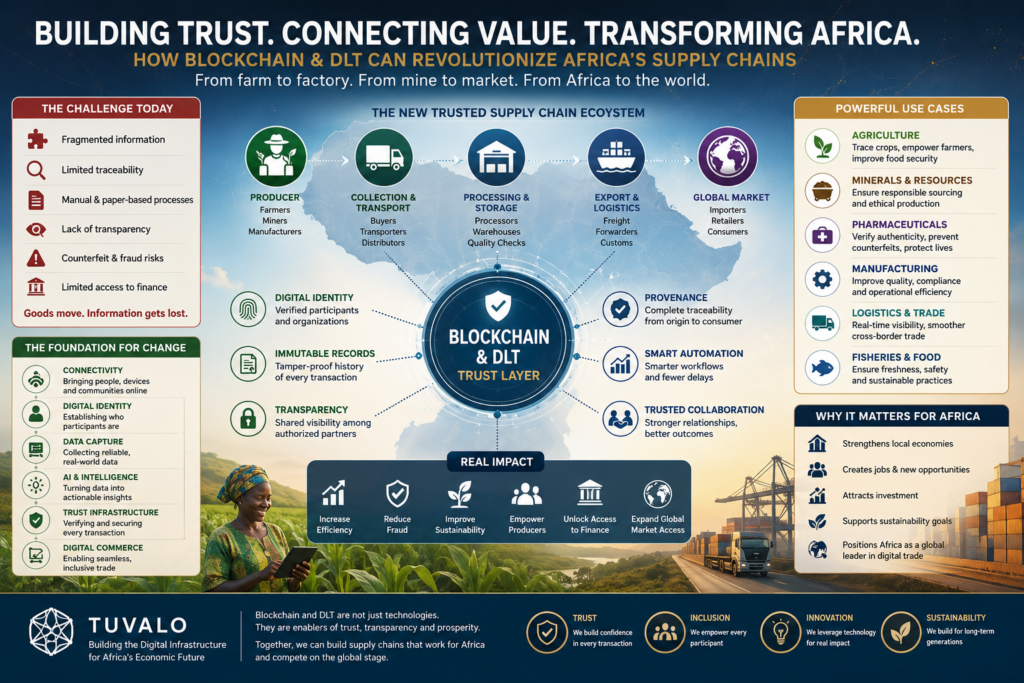
Africa’s Supply Chain Challenge
Today’s Reality
Many African supply chains depend on multiple participants:
🌱 Producers
Farmers, miners, manufacturers
⬇️
🚚 Local Networks
Buyers, transporters, warehouses
⬇️
🏭 Processors
Factories and exporters
⬇️
🌍 Global Markets
International companies and consumers
At every stage, information can become fragmented.
Common challenges include:
| Challenge | Impact |
|---|---|
| Limited product traceability | Difficult to prove origin |
| Paper-based processes | Slow verification |
| Fragmented databases | Poor coordination |
| Limited producer data | Restricted financing |
| Counterfeit risks | Loss of trust |
| Compliance pressure | Barriers to global markets |
The physical product moves.
The trusted information often does not.
Blockchain as a Digital Trust Layer
Blockchain and Distributed Ledger Technology introduce a new possibility:
Turning Physical Products Into Verifiable Digital Records
A physical product can be connected to a trusted digital history.
Example:
Traditional Product Journey
🌱 Farm
⬇️
🚚 Transport
⬇️
🏭 Processing
⬇️
🌍 Export
⬇️
🛒 Consumer
Information is often scattered across separate systems.
Digitally Verified Product Journey
🌱 Origin Verified
⬇️
📍 Location Confirmed
⬇️
📋 Quality Recorded
⬇️
🚚 Movement Verified
⬇️
🌍 Buyer Authentication
The product carries a trusted story.
Agriculture: Empowering Africa’s Producers
Agriculture remains one of Africa’s most important economic sectors.
Yet many smallholder farmers face challenges:
- limited access to finance,
- weak market information,
- lack of production records,
- difficulty proving sustainability practices.
Digital trust systems can create a new economic identity for producers.
The Future Digital Farmer Profile
A farmer’s verified economic history could include:
🌱 Farm Information
📍 Production Location
📈 Yield History
✅ Certifications
💰 Transaction Records
🌦 Environmental Data
This creates new opportunities:
Better Access to Finance
Financial institutions can better understand agricultural activity.
Better Government Support
Programs can reach verified producers more efficiently.
Better Global Market Access
Buyers can verify the origin of products.
Cocoa: A Global Example of Digital Traceability
Africa produces some of the world’s most important agricultural commodities.
Cocoa provides a powerful example.
A future digital cocoa ecosystem could connect:
Farmer
↓
Buying Network
↓
Processing
↓
Export
↓
Global Buyer
At each stage, trusted information can be recorded:
- origin,
- quality,
- sustainability information,
- movement history,
- certifications.
The result:
“Proof of Origin” for African Commodities
A buyer purchasing African cocoa, coffee or other products can have greater confidence in the story behind the product.
Minerals: Creating Responsible Resource Networks
Africa’s mineral resources are critical to the global economy.
Industries increasingly require proof of:
- responsible sourcing,
- ethical production,
- environmental compliance.
Distributed ledger systems can help create stronger connections between:
⛏ Resource Origin
⬇️
🏭 Processing
⬇️
🚢 Export
⬇️
🌍 Global Manufacturing
This creates greater transparency across complex international supply chains.
Logistics: Moving From Tracking Goods to Trusting Goods
Modern commerce depends on logistics.
But logistics networks often involve many disconnected systems.
A trusted digital network can improve collaboration between:
- suppliers,
- transport companies,
- warehouses,
- customs authorities,
- retailers.
The objective is not replacing existing businesses.
It is enabling them to coordinate with greater confidence.
The African Reality: Infrastructure Comes First
Blockchain alone is not the answer.
A successful digital economy requires several layers working together:
The Digital Economy Stack
Connectivity Layer
Connecting people, communities and businesses.
↓
Identity Layer
Knowing who participants are.
↓
Data Layer
Creating reliable economic information.
↓
Intelligence Layer
Using AI to generate insights.
↓
Trust Layer
Verifying transactions and records.
↓
Commerce Layer
Enabling economic exchange.
From Digital Currency to Digital Economies
The first blockchain era focused on:
“How can we create digital money?”
The next era focuses on:
“How can we create trusted digital economies?”
Africa’s opportunity is to apply blockchain principles to real economic activity:
- agriculture,
- trade,
- logistics,
- manufacturing,
- finance,
- sustainability.
The Future Vision: Trusted African Trade Networks
Imagine an ecosystem where:
Producers
Can prove what they create.
Businesses
Can verify what they buy.
Governments
Can understand economic activity.
Financial Institutions
Can evaluate previously invisible markets.
Consumers
Can trust the products they purchase.
The Strategic Opportunity
Africa does not need to copy every technology trend.
It can apply emerging technologies to solve its own structural challenges.
The future is not only about digital assets.
It is about creating:
Trusted Digital Infrastructure for Real Economic Value
Where physical goods, economic participants and global markets become more connected through secure digital systems.
Tuvalo Perspective
The next generation of digital transformation will be defined by technologies that connect the physical and digital worlds.
Blockchain, distributed ledger technology, artificial intelligence and resilient connectivity together can help build more transparent, efficient and inclusive economic networks.
The greatest opportunity is not simply creating new digital assets.
It is creating the infrastructure that allows the world to trust, verify and unlock the value of Africa’s real economy.