


Why the age of AI-generated software is making human judgment more—not less—important
For decades, software development was constrained by capability.
Could someone write the code?
Could a team afford the developers?
Could they find the right technical skills?
Could the project be delivered within the available time and budget?
Artificial intelligence is changing that equation.
With increasingly capable AI coding systems, software that once required substantial teams, months of engineering effort and considerable capital can now be prototyped, assembled and iterated with dramatically less friction.
The economics of software creation are changing.
The technical barrier is moving.
And as it does, an important question emerges:
If almost anyone can increasingly build software, what should they build?
At Tuvalo, we believe that is only the beginning of the question.
The deeper question is not merely what should be developed.
It is what, how, why, where and when.
And increasingly, these questions cannot be separated.
From “Who can build?” to “What should be built?”
The traditional software industry has largely organized itself around capability.
The scarce resource was the software engineer.
A business had an idea. It then needed programmers capable of translating that idea into software.
The better the programmers, the greater the technical possibilities.
AI is disrupting this model.
A person with comparatively limited conventional programming experience can now describe an application, generate code, inspect results, ask for changes, troubleshoot errors and progressively construct increasingly sophisticated systems.
This is enormously consequential.
But it creates a new problem.
When the cost and difficulty of producing software decline, the number of things that can be built rises faster than the number of things worth building.
That distinction matters.
The world does not necessarily need more software.
It needs better software.
It needs systems that solve meaningful problems, work reliably, respect their users, fit their environments, survive contact with reality and produce outcomes that are actually worth producing.
AI therefore does not eliminate the need for judgment.
It makes judgment more important.
The What
The What is the object of development.
What exactly are we building?
What problem does it address?
What users does it serve?
What capabilities should it possess?
What should it deliberately not do?
What constitutes success?
These questions may appear obvious, but they are frequently where software projects begin to go wrong.
A vague idea can now become a functioning prototype remarkably quickly.
That speed can create the illusion of progress.
A prompt such as:
“Create a platform that helps businesses manage their customers.”
may produce an impressive application.
But an impressive application is not necessarily a good product.
The AI can generate interfaces.
It can generate database schemas.
It can generate APIs.
It can create authentication systems, dashboards, workflows and integrations.
But the existence of these things does not answer the fundamental question:
Should this particular system exist in this particular form?
The What therefore requires product judgment.
It requires understanding users, institutions, markets, environments, constraints and unintended consequences.
The question is not simply:
“What can AI build?”
It is:
“What is worth building?”
The How
This is where some of the popular narratives surrounding AI development become misleading.
AI-assisted development is sometimes presented as if software creation has become a matter of issuing increasingly sophisticated natural-language commands.
“Build me an app.”
“Add payments.”
“Make it mobile.”
“Fix the error.”
“Add an AI assistant.”
There is certainly value in conversational development.
But serious software does not emerge from prompts alone.
The How is a discipline.
It involves architecture.
It involves decomposition.
It involves sequencing.
It involves understanding dependencies.
It involves testing.
It involves security.
It involves data structures.
It involves deployment environments.
It involves observability.
It involves version control.
It involves knowing when generated code is appropriate—and when it is not.
It involves understanding what the AI has actually done rather than merely accepting that something appears to work.
And, perhaps most importantly, it requires the human co-developer to understand enough about the system to direct the AI intelligently.
The distinction is profound.
A person who tells an AI:
“Build me a banking system.”
is asking for something radically different from a person who can reason through identity, authentication, authorization, transaction integrity, ledgers, reconciliation, auditability, fraud controls, failure states, regulatory requirements, data protection, availability and recovery—and then use AI to help implement those requirements.
The latter is not merely prompting.
It is engineering with AI.
AI Does Not Remove the Need to Understand Systems
One of the great misconceptions of AI-native development is that understanding the underlying technology becomes unnecessary.
In reality, the opposite may increasingly be true.
The less a human understands about the system being constructed, the more difficult it becomes to determine whether the AI’s output is correct.
AI can produce code that compiles.
It can produce interfaces that look convincing.
It can produce architectures that sound sophisticated.
It can even explain its own decisions persuasively.
None of those things guarantee that the resulting system is sound.
A capable AI can also confidently construct the wrong thing.
It can misunderstand a requirement.
It can make an inappropriate architectural assumption.
It can introduce hidden coupling.
It can solve a local problem while creating a systemic one.
It can optimize for the prompt rather than the product.
It can fix one failure while weakening another part of the system.
Consequently, the human developer increasingly becomes something more than a coder.
The human becomes:
architect, critic, investigator, teacher, tester, product thinker, systems thinker and ultimately accountable decision-maker.
The Mature Mind
This is perhaps one of the least discussed aspects of AI-assisted software development.
The quality of the outcome is influenced not only by the capability of the AI, but by the quality of the human thinking that surrounds it.
There is a difference between knowing how to ask an AI for something and knowing what to ask, when to ask it, why to ask it, what evidence to demand and when to reject its answer.
That difference grows as systems become more complex.
A mature AI co-developer learns to interrogate the machine.
Instead of:
“Make this better.”
the instruction becomes:
“Here is the intended behavior. Here are the constraints. Here is the existing architecture. Here is the failure mode. Identify the likely causes, distinguish evidence from assumptions, propose alternatives, explain the trade-offs, and implement only after we establish which approach is appropriate.”
That is a fundamentally different relationship with AI.
The human is not surrendering thought to the machine.
The human is using the machine to extend thought.
The Long, Careful Journey
There is another important reality that can become obscured by demonstrations of instant AI-generated applications.
Serious AI-assisted development is often a long journey.
The first generation of a system may be crude.
The second may reveal architectural weaknesses.
The third may expose requirements that were never initially considered.
Testing may reveal unexpected behaviors.
Users may behave differently from what was anticipated.
The AI itself may need to be corrected repeatedly.
The developer may discover that an assumption made at the beginning was wrong.
A feature that appeared simple may turn out to affect five other systems.
A seemingly minor change may expose a deeper architectural question.
This is not failure.
It is development.
AI simply changes the speed and nature of the iteration.
The development process becomes a dialogue:
human → AI → system → evidence → human → AI → system → evidence
and the cycle continues.
Both participants learn.
The human develops a better understanding of the system.
The AI is progressively given better context, constraints and feedback.
The resulting software can become substantially more sophisticated than the original conception.
This is why patience matters.
The Why
But even a technically excellent product can be wrong.
This is where Tuvalo places the Why.
Why should this system exist?
Why should these particular capabilities exist?
Why should these users trust it?
Why should this business model exist?
Why should this data be collected?
Why should this decision be automated?
Why should this activity be optimized?
And ultimately:
What conception of the world does this software embody?
Software is never completely neutral.
Every significant system contains assumptions about people.
It makes assumptions about incentives.
It establishes permissions.
It determines what is visible and what is invisible.
It decides what is measured.
It determines what is automated.
It establishes relationships between institutions and individuals.
It can empower.
It can exclude.
It can concentrate power.
It can distribute opportunity.
It can create dependency.
It can protect human agency—or gradually erode it.
Therefore, a commercial objective is not sufficient justification for a sound product.
“People will pay for it” does not necessarily mean it should exist.
“Businesses will become more efficient” does not tell us whether the efficiency is desirable.
“Users want it” does not automatically resolve questions of social consequence.
“AI can do it” is perhaps the weakest justification of all.
The Why requires worldview.
It requires objectives.
It requires values.
It requires moral reasoning.
And increasingly, it requires asking whether the technology serves human beings or merely optimizes them.
The Where
The Where introduces another dimension that is particularly important in the AI era.
Where should the system be developed?
Where should its intelligence reside?
Where should data be processed?
Where should models run?
Where should information be stored?
Where should computation occur?
Where should the system be deployed?
And, importantly:
Which AI development environment is appropriate for the work?
The AI development ecosystem is becoming increasingly heterogeneous.
Different models and platforms have different strengths.
Some excel at reasoning.
Some excel at coding.
Some are optimized for rapid prototyping.
Some provide powerful development environments.
Some offer stronger enterprise controls.
Some are better suited to particular programming ecosystems.
Some provide specialized tools, agents or integrations.
Others may be appropriate for privacy-sensitive or highly controlled environments.
Consequently, “use AI” is no longer a sufficiently sophisticated technical strategy.
The question becomes:
Which intelligence, tools, models, environments and infrastructure should participate in which part of the development process?
This may eventually become as important as selecting programming languages and cloud infrastructure.
The When
Then comes When.
When should something be built?
When should it be launched?
When should an AI model be introduced?
When should a feature be automated?
When should a human remain in the loop?
When should a system be rewritten?
When should an experimental capability become production infrastructure?
And perhaps most importantly:
When should we deliberately choose not to build?
Technology creates a persistent temptation toward immediacy.
Because AI can produce something today, there is pressure to produce it today.
But capability does not determine timing.
A system can be technically possible and commercially premature.
A market can exist but not yet be ready.
A technology can work but be insufficiently mature.
A regulatory environment can be unsettled.
A dependency can be too fragile.
A business model can be premature.
A society may not yet understand the consequences of a particular capability.
Good development therefore includes restraint.
Sometimes the most sophisticated engineering decision is:
not yet.
Beyond Prompt Engineering
Tuvalo therefore sees a distinction between prompting and AI-native development.
Prompting is a technique.
AI-native development is a methodology.
A prompt may initiate an action.
A methodology governs an entire process.
The serious AI co-developer must be capable of:
- defining objectives;
- establishing constraints;
- decomposing complex problems;
- understanding system architecture;
- providing relevant context;
- interrogating assumptions;
- evaluating AI-generated output;
- testing hypotheses;
- identifying failure modes;
- maintaining coherence across iterations;
- managing technical debt;
- protecting security and privacy;
- validating behavior against requirements;
- understanding deployment realities;
- and continuously asking whether the resulting system remains faithful to its original purpose.
This requires technical literacy.
But it also requires intellectual discipline.
The AI Is a Co-Developer—Not an Oracle
At Tuvalo, we increasingly find the language of co-development more useful than the language of automation.
The AI is not necessarily replacing the developer.
Nor is the developer simply commanding the AI.
A more productive model is collaborative.
The human contributes:
purpose, judgment, context, experience, responsibility and direction.
The AI contributes:
scale, speed, recall, synthesis, implementation capacity, experimentation and tireless iteration.
Neither contribution is sufficient by itself.
An AI can generate thousands of lines of code.
But it does not thereby acquire responsibility for what those lines mean in the world.
The human remains accountable.
That accountability becomes more—not less—important as AI becomes more capable.
From Software Engineering to Software Stewardship
This leads to a broader proposition.
The evolution of AI-assisted development may eventually shift the professional center of gravity from software engineering alone toward software stewardship.
Engineering asks:
Can we build it?
Stewardship asks:
Should we build it, how should we build it, for whom, under what conditions, using which technologies, at what time, and with what consequences?
The latter encompasses engineering but goes beyond it.
It incorporates product thinking, institutional thinking, ethics, economics, systems theory, human behavior and long-term responsibility.
This is particularly important for infrastructure-level systems.
The more deeply software enters commerce, government, education, finance, logistics, communications, identity and everyday life, the less acceptable it becomes to treat software as merely code.
Software becomes part of the environment in which people live.
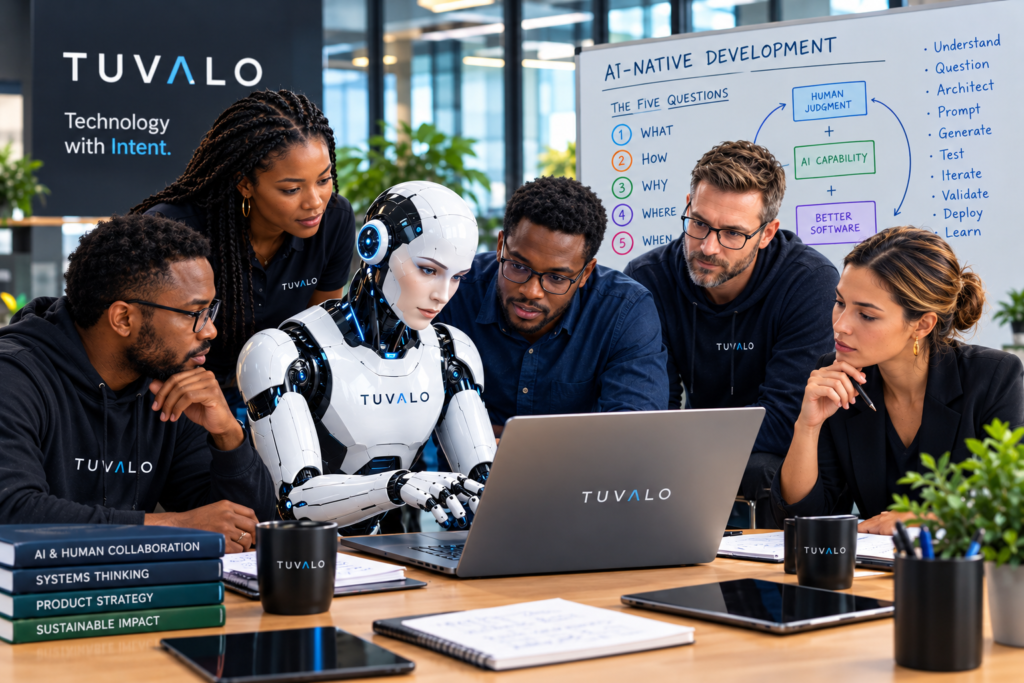
The Five Questions
Tuvalo’s proposition can therefore be summarized through five questions:
1. WHAT?
What should be built?
Define the problem, the user, the purpose and the desired outcome.
2. HOW?
How should it be built?
Determine the architecture, methodology, technology, AI collaboration model, safeguards and development process.
3. WHY?
Why should it exist?
Examine purpose, worldview, incentives, morality, human consequences and long-term value.
4. WHERE?
Where should it be built and operated?
Consider models, platforms, infrastructure, jurisdiction, data, computation, deployment environment and ecosystem.
5. WHEN?
When should it be built, deployed, changed—or deliberately postponed?
Consider readiness, timing, maturity, economics, regulation, dependencies and social context.
Together, these questions transform AI-assisted development from an exercise in generating software into an exercise in deliberate technological creation.
The New Scarcity
The irony of the AI revolution is that while it may make software development abundant, it may make good judgment scarce.
Code is becoming easier to produce.
Prototypes are becoming easier to produce.
Applications are becoming easier to produce.
Even complex systems are becoming increasingly accessible to smaller teams.
But discernment remains difficult.
Knowing what matters is difficult.
Knowing what does not matter is difficult.
Knowing when an AI answer is wrong is difficult.
Knowing what questions have not yet been asked is difficult.
Knowing the consequences of a system before those consequences appear is difficult.
And knowing when to stop building may be harder still.
The competitive advantage of the future may therefore belong less exclusively to those who can write the most code and increasingly to those who can think most clearly about what the code is for.
Tuvalo’s View

Tuvalo does not see AI-assisted software development as the end of software engineering.
We see it as a transformation of the discipline.
The machine increasingly participates in the construction.
The human increasingly participates in the direction.
And the boundary between the two will continue to evolve.
But one principle should remain constant:
The easier it becomes to create technology, the more carefully we must decide what technology deserves to be created.
The future developer will not merely be someone who knows a programming language.
Nor will the future AI-native developer merely be someone who knows how to write clever prompts.
The deeper skill will be the ability to understand systems, understand AI, understand people, understand context, understand consequences—and bring these understandings together into a coherent act of creation.
That is a longer journey.
It is slower than the marketing demo.
It is more demanding than a prompt.
And it is considerably more interesting.
Because the real promise of AI in software development is not that humans can finally stop thinking.
It is that, with the right discipline, humans can think at a much greater scale.
TUVALO INSIGHTS
Technology • Systems • Enterprise • Human Development
Tuvalo Insights explores the ideas, systems and emerging technologies shaping the future of African and global enterprise.
NB: This article presents general principles and observations concerning AI-assisted software development. It does not disclose Tuvalo’s proprietary software, source code, confidential technical architecture, trade secrets, internal development processes, or other non-public intellectual property.